Sunday, November 13, 2011

Migration Analysis


Before I left on migration, I managed to squeeze in a quick presentation on all of the migration analysis work I've been doing. Essentially, here's what I found so far:

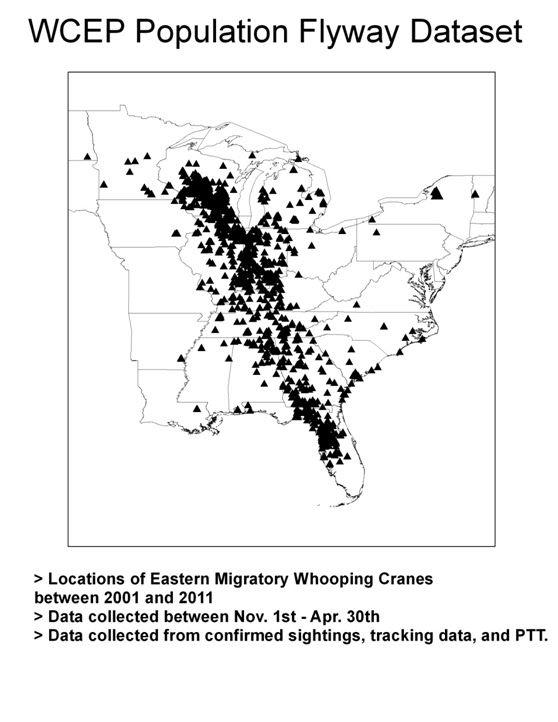
All of the whooping crane migration data looks like this. Note that it is roughly 36,000 data points over 10 years in the fall through spring migration months.


Based on a paper by Tacha, et. al. I created an average fly line using all the points. Well, actually I made two, the first fly line (orange) was waaay too jagged for my purposes. The second (blue), using almost twice as many data points for the average was smoother and more suitable to my purpose.


This was my final choice for the fly line.

After that, I wanted to find what percentage of the population was using land near the average fly line. Are all of the birds using this basic route? are half the birds using this route?

So I calculated what percent of the birds were within a certain distance from the line. It looks like this.
This says that 75% of the birds over 10 years of sightings are within 10 miles of the average fly line! This seems unbelievably small given what I know about this population. So I wanted to find out if maybe there was a heavy skew at both ends of the line. There are many sightings of birds on home ranges before they leave for migration and after they end migration in this data set.

In an effort to remove the skew, I didn't address Wisconsin and Florida at all in my next set of calculations:
As you can see, there's a drastic difference between the first set of calculations and the second. This new graph shows that along the flyway, 75% of the cranes are within a 150 mile corridor of the average fly line. If the first set of calculations was too good to be true, then this set of calculations is almost too big to be of any use. How are we supposed to tell Indiana that in order to take local action that would protect the the whooping cranes, they have to cover the ENTIRE STATE? most of the cranes don't fly through the North Eastern quadrant of the state, but you wouldn't know that from this map.

As you can see, I still have some work to do. I would like to include Wisconsin and Florida without skewing the data, and I would like to have a solid product to leave the Crane Foundation with when my internship is through.

I hope I didn't bore you with too much science. Here are some pretty crane flight pictures that I included in my presentation. These are all provided by Eva.


Saturday, October 22, 2011

2011 DAR Release

It's that time of year again. Eight young whooping cranes have been released on the Wisconsin landscape near Horicon Marsh area. We released the birds in groups of threes and fours last year, but this year is a little different because they released the 8 birds together in the same location. I hear they all survived their first night in the wilderness so the future looks promising. Up to this point I have had no interaction with the 2011 cohort, but now that they are released, it will be my job to track them and monitor how they are doing. I can't wait. Good luck, chickies!

Tuesday, October 18, 2011

Victory!

After 3 months of intense, grueling labor we have uploaded most of the old data into the new database!!

What a relief. Now that we all have access to 10 years of whooping crane tracking data. Let's do some conservation!

Here's what it looks like
:D

Saturday, October 15, 2011

Whooping Crane Capture

Wednesday, when I found 1/2 the population of whooping cranes within an 8 mile radius, I identified an injured whooping crane. She had twine wrapped around her right leg so tight, it caused a swelling so large it looked like a second hock. She wasn't placing any weight on her leg, so I called Eva right away.

17-07 using wings to step forward

17-07 is 4 years old. Two weeks ago, Eva saw her with a slight limp, but didn't observe any twine. It wasn't notable at the time since wild birds will develop a limp and miraculously heal within a week sometimes. This time, when I saw her, I was very alarmed at her limp and the swelling around the twine. While other cranes danced around her, foraged in the corn, and acted generally crane-y, she just rested on her left foot and poked around her at the corn nearby. I watched her for an hour trying to get video footage of her behavior. She didn't move around very much and when she did, she used her wings to assist her movement.


After working long hours on Wednesday, finding landowners and obtaining permission to go on their land, we were ready to go for Thursday. Thursday morning, Eva and I found the cranes weren't on that land anymore. Oh well. So we worked another couple hours trying to find the new landowners and get their permissions. It's a little disappointing when that happens: we were pawing at the gates to begin our capture adventure on Thursday only to be set back by the cranes' desire to forage on new land.

OK, so we got permission, and by late Thursday afternoon, we had our team organized: Richard Urbanek (a.k.a. Crane Guru), Eva, and myself. This was an opportunistic capture because her transmitter is dead; we planned to remove the twine binding her leg AND put new leg bands on. Awesome! I think the saying goes 'two birds with one stone.'

Sadly, on that late Thursday evening, the birds flew off both times we approached the birds in cornfields. Maybe they flew because we were trying to entice the birds with corn in a corn field. Maybe they flew because the birds felt less secure in a cornfield than they do in a marsh. Who's to say?

We regrouped for a Saturday morning capture. This time, we were without Richard Urbanek, so we couldn't replace the transmitter. We also couldn't capture the birds with our usual capture technique with the Net Gun. We were handicapped by our need to be close enough to physically grab the bird before she flew away. Nonetheless, we moved forward with the plan because it is only humane and right that we remove the fishline from 17-07's leg. Otherwise, it would eventually lose circulation and fall off.

Saturday morning, the team included Nancy and Annette, 2 vet techs who are experienced in field medicine and animal rehabilitation, Eva and myself. THIS time the cranes were on land we had permission to enter so we got started right away.

Eva and myself walked up to a group of 7 whooping cranes (27-10, Feta, included :), and they didn't fly off! Odds of capture were looking good. As Eva and I pretended to be cranes, chucked grapes at the greedy adults, and worked our way closer, 17-07 didn't react. Eva moved slowly towards 17-07 while I distracted the other 6 cranes, including 17-07's suspicious 'boyfriend,' 10-09. Finally Eva was close enough! There was a brief struggle of feathers and costume but Eva quickly had 17-07 in hand and walked her back to our mini field station. We had set up in the tall grasses to block the view of the other birds.

Eva moves slowly towards injured 17-07
Nancy and Annette analyzed the wound, removed the fishing line, and took pictures while Eva held the bird. I warded off unwanted company (meaning the 6 other whooping cranes who rushed to investigate).
Removing the twine carefully with suture scissors

Right leg swelling due to pressure from the twine
After the twine was removed the swelling should go down
When I was satisfied the other birds would stay at the other end of the pond, I returned to assist in any way I could. Eva had me remove the old, non functioning transmitters. 17-07 is now the only bird in the Eastern Population that does not have any color bands to identify her.


I'm removing the non-functioning transmitters

The vet techs have decreed that she is in good standing. She should recover very quickly (they suggested she'd recover within the week!) because we removed the fishing line before it caused severe damage. If we had not caught her the tissue around the twine would continue to swell, working the twine farther into the leg and cutting off circulation.
Eva releases the bird into the marsh

I feel so great about this capture today! We were lucky with the crane's location, landowner permission, disposition of the cranes, and everything else that went right today. I only wish we could have re-banded her while we had her in hand.


Can you believe this fit around her leg?

Wednesday, October 12, 2011

1/2 the population in one day

Yes, 50 cranes is a lot. But I did it. Pictures to come.

Tomorrow, we're going to try to capture an injured crane. What a week.

Thursday, September 1, 2011

Picture Dump

 Things I've Seen
Porcupine

Pelicans (Lots of Pelicans)

Goslings! with cute baby bottoms

Kingfisher

Cormorants!

Cranes Being Cranes

12-05 and 22-07 just sitting. lazy cranes.

27-10 (Feta) my beautiful girl

W1-10 stuffing herself silly while the flowage is drained.
Cranes Reproducing

Male standing over female while she is trying to lay an egg

46-07 sitting tight on nest on a very smokey day (controlled burn nearby)

Crane Momma and baby

Out of the Field, Into the Office

So I bet you are wondering what I've been up to to keep me away from my blog for so long...

Office work! Yes, I've been sitting at a computer for the past four weeks working in the office on nominally interesting topics such as Database, Historical Data, and Data Entry.

I feel uninspired to write about these things, so I'm sorry I've left you in the dark for so long.

Here's the good news: I've been working so hard at switching all the historical data from the old database format to the new database format that it's all about to pay off. We have 10 years of tracking data in the old database. 10 years of migrations. 10 years of molts. 10 years of nesting seasons. 10 years of juvenile releases. All of that information is now readily available to everyone involved in the Whooping Crane Eastern Partnership. This means that we can write new papers, evaluate how the project has progressed, and determine where we should be channeling our energy in the future.

I'm pretty proud of the work I've done so far.

Now I'm ready to work on a study of my own.

And I can, now.

Because my contract has been extended through December. :D

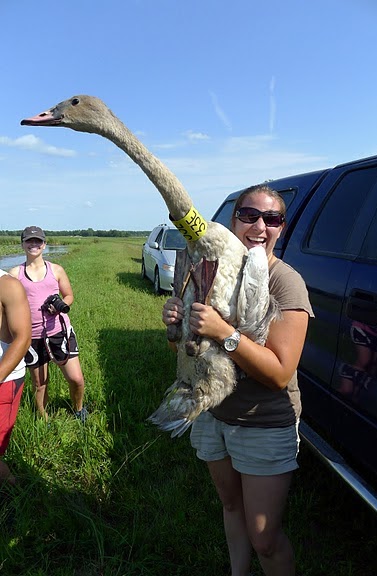
(I've also been working with Sandhill Cranes and Trumpeter Swans)