So I bet you are wondering what I've been up to to keep me away from my blog for so long...
Office work! Yes, I've been sitting at a computer for the past four weeks working in the office on nominally interesting topics such as Database, Historical Data, and Data Entry.
I feel uninspired to write about these things, so I'm sorry I've left you in the dark for so long.
Here's the good news: I've been working so hard at switching all the historical data from the old database format to the new database format that it's all about to pay off. We have 10 years of tracking data in the old database. 10 years of migrations. 10 years of molts. 10 years of nesting seasons. 10 years of juvenile releases. All of that information is now readily available to everyone involved in the Whooping Crane Eastern Partnership. This means that we can write new papers, evaluate how the project has progressed, and determine where we should be channeling our energy in the future.
I'm pretty proud of the work I've done so far.
Now I'm ready to work on a study of my own.
And I can, now.
Because my contract has been extended through December. :D
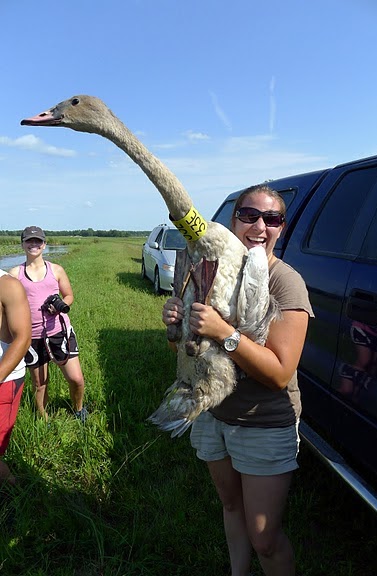
(I've also been working with Sandhill Cranes and Trumpeter Swans)
Thursday, September 1, 2011
Friday, July 15, 2011
Sad, Strange Events
Pairs of whooping cranes are dying. It has happened twice this season. Four birds gone from our small population of ~100 is approximately 4% of the population! Wiped out.
In both cases one bird had been long deceased and the second was recently deceased. I've added details about both pairs below the break. Before you click on it, know that we have no idea why they died excepting 31-08's death is probably predation.
Wednesday, June 29, 2011
Sandhill Chick Capture June 29th, 2011
![]() |
| His ears are a little askance, but the hood serves its purpose |
![]() |
| Nicole, Jamie, and Eva diligently watch the Sandhill family for two straight hours |
We waited for 2 hours while the Sandhill family slowly (I would like to emphasize SLOWLY) walked into position for our ambush team on the ground. As soon as the family was far enough away from the marsh and protective cover, the ground crew made a run for them. I do NOT look away from my scope. My job is to keep an eye on the young cranes while the adults are flushing because the young may drop out of sight and hunker down in the grasses at any moment. It didn't take long. The whole thing took 2 seconds at most before there were no more cranes in view. The adults had flown off and the chicks had hidden in the grasses. The ground crew reached location at about 3 seconds in.
![]() |
| A frustrated Ground Crew with no chicks in sight |
Well all that excitement was for naught. We didn't find the crane babies. They hid very well. Sometimes the young will poke a head up to see if the danger is gone, so we waited for another 30 minutes. Nothing.
It's strange how somethings work out, though. As we were exiting the scene, we happened to see one of the juveniles pretty far away, right on the side of the road! I see the car in front of us pull off the side, 3 men spill out of the car and RUN. They caught the chick before we even managed to park the car. As I walked up, the chick was already hooded (see above; a nice volunteer sewed these cute hoods for the cranes), and securely wrapped up in Dan's arms.
What we do:
Age estimate (based on eye color because they change from blue to slate grey to orange or yellow)
Check feather growth on the wings (make sure those blood feathers are ok)
Blood sampling (for gender and other health reasons)
Measure the beak and legs
Weigh the bird
Band the bird; USFWS silver, colored bands, and numbered band
![]() |
| Andy Measures the Beak |
Population monitoring; by tracing how many times we see marked birds we can estimate population size, population age, survival, habitat use, etc.
By sampling blood and taking physical measurements, we can estimate the health of the population or the suitability of the habitat the cranes are using.
![]() |
| Matt takes the weight while Dan is close by for safety |
This chick was in hand a total of 20 minutes, which is pretty fast for all the analysis we do. Dan and Anne released the chick, who calmly ran towards the safety of the marsh and the reassuring presence of his parents.
![]() |
| Dan allows the chick to gain his footing before release as Anne supervises |
![]() | |
| The expert stops a hematoma from forming while ensuring no pressure on windpipe/esophagus |
![]() |
| Mike and Matt release the second bird |
![]() |
| There he goes, "Catch ya later!" |
![]() |
| Eva and I watch in fascination as Matt tries to warm up the BIG band. |
![]() |
| Second chick, second hood :) |
Friday, June 17, 2011
Cranes and Trains
29-09 is molting. Or we're pretty sure he is. He hasn't moved from this strange area in the middle of the woods for the past 3 weeks.
He's all alone. Something's fishy. Eva and I were discussing his strange behavior last week when Dan, one of the Field Ecology interns, was in the room. Eva mentioned that 29-09 might be in molt. Dan's intern project is about molting cranes. Why don't we send Dan in to go find 29?
Well, there's a problem. This location is adjacent to an old abandoned train. Last year, Matt Strausser the tracking intern, went in to find a different bird molting in the same area but he came back with stories of homeless people living in the train. So it's really unsafe for someone to go back there alone.
Dan and I went back there together for safety. We saw a crane REALLY far away (above is through scope) but we wanted to get a little closer. So we walked closer along the train tracks hiding in the bushes between the marsh and the train.
We came across some obstacles along the way, like a deep ditch. I crawled under the train to cross the ditch only to discover that there was a nice beaver-dam bridge that had been hidden by dense willows. The ditch was perfectly cross-able, so there was no reason to crawl under the train.
We found some delectable wild strawberries.
Once we were closer, we climbed the train to scan the area. Nothin'. We couldn't see nothin'. So we got to hang out for an hour and play on the train. Really, we were just trying to reach higher ground to try to see over the bushes, but I'll admit it was a little fun to climb into the cars. They make it really had to climb to the roof of the train, just so you know.
It makes sense that 29-09 would hide if he can't fly. We know he was in the area because his signal was really strong. He either hunkered down into the tall grasses or he walked back into the woods. Cranes ain't dumb; they know when to hide. I just hope he comes back to the area because it seems like a safe area from predators.
In short: Fun adventure. We know 29-09 is alive, but we can't confirm that he's really molting.
Tuesday, June 14, 2011
Youngest bird to lay eggs in the EMP
![]() |
| 33-07 and 5-09 looking intimidating |
Back to subject: Yes, you heard me!!! The YOUNGEST bird to ever lay an egg in this population was 5-09 shown above, right. The egg did not hatch after 40 days (10 days past the time it takes for a chick to hatch), so Eva and I were sent in to collect the egg. These two birds are a young couple. They associated with each other last year in a large group of young cranes, but this year things became a little more intense. They started defending their territory and they built a nest.
Eva and I didn't know what to expect when they started sitting on the nest. Cranes take turns incubating eggs so both birds have a chance to relax, stretch their legs, and get a little food multiple times a day. We wouldn't have been surprised if just the female was the only one sitting on the nest in early May, but 33-07 (the male) was taking an active role in sitting on the nest and defending the territory. Something seemed a little suspicious. So we watched and waited. Eventually we observed that they were rolling something in the nest. But what? We speculated they adopted rocks, maybe a turtle (poor hypothetical turtle), and then we started thinking that it could really be an egg by the end of May.
We gave them more than an extra week to try to hatch whatever they had in there. Birds will abandon naturally if nothing happens after 30 days (the usual incubation period). This young couple had a really great nesting experience during their first year together. (And may I add that they had a lovely home)
![]() |
| 5-09 flying near the nest |
As Eva and I approached the nest we discovered it's an egg! It's really an EGG! and what a handsome nest. We were half expecting 33-07 to attack us. The landowner and his family was expecting it, too. They were standing by with their cameras ready for the excitement. 33-07 and 5-09 rushed us while we were still in the canoe, but once we got out of the canoe the birds flew off and threatened us from a distance. I'm glad it didn't come to any close contact because 33-07 seems really mean (the landowner says 33 defends an entire cornfield from all other birds... really... that's just excessively territorial. Add to that the time I saw 33-07 attack a Canada goose; they were both mid-flight and he bit the goose by the tail feathers and threw it down to the marsh... I was really scared).
So we were lucky not to have close contact. I just tried to look really big and intimidating so it wouldn't come to man-v-crane. What an exciting day.
![]() |
| Defense against the Dark Cranes |
P.S. the egg was definitely not going to hatch. It smelled terrible (yup, like rotting egg).
All pictures in this post were taken by Eva. Thank you, Eva!
Friday, June 10, 2011
23 and 26 update
![]() |
| 26-10 (Goat) and 23-10 (Ricotta) |
Before they arrived in Dunn County, they were reported in Indiana. Dan, the observer, sent us this little story:
I checked on #'s 23 and 26-10 in Scott County this morning. When I
arrived at 8 AM they were about .6 of a mile back away from the road.
They were walking fast in single file in an open area. Seemed odd and
so I stayed to watch. Once they got close to a wooded area they turned
and raised their wings. And started running.
At first I thought they were taking flight until I saw the coyote
running away from them. I had to put the spotting scope on it to
confirm, yes it was a coyote they were chasing! Once the coyote got
some distance between them it slowed down and walked away with it's tail
between it's legs.
The birds slowly walked back out to the flooded fields. Man I wish I
had been close enough to photograph that!
I wish he was close enough, too! Well, I'm proud of these two birds. 26 and 23 survived many ordeals together, and I think Dan's story shows that they've become stronger (and more intimidating) as they've grown. Since they are male and female, respectively, I wonder if they will stay together. Only time will tell, but I think they make a cute couple, don't you?
| 23-10 and 26-10 roosting |
Friday, April 22, 2011
New Tracking Van: test run
| Toyota Tracking Van: toro! toro! |
It's finally here! The new tracking van is amazing. ICF received a grant to replace the old-school full-sized astro van with this modern Toyota Sienna. It's rugged, it has enough room in the back to transport Cranes or lots of people, AND it's a beautiful ICF blue. How could it get any better?
The antenna is controlled by a state-of-the-art consul system that allows you to stay inside the vehicle to get an azimuth (or direction) on the bird once you know what direction the van is pointing. If you don't know that, then you have to get out of the vehicle and measure that with your compass.
| The handle at the top lets you spin the antenna |
![]() |
| Triangulations, error, and where we place the bird accordingly |
Unfortunately, it was a miserable snowy day in mid-April. This is the first time I've experienced Thunder Snow; I didn't even know it existed. I thought storms stopped for the winter season. I guess you learn something new everyday.
| a beautiful Easter Wonderland |
| New tracking van is so rugged, it can handle this! |
| I'd love it more if the weather played fair. |
Subscribe to:
Posts (Atom)